Start with the thing that will save you the most money: put the caustic drain cleaner back on the shelf.
Those products often bore a narrow channel through a blockage rather than removing it, so the clog returns within weeks. They generate heat, which can deform PVC and damage older pipes and seals. And when they do not work, you have handed a plumber a pipe full of standing caustic liquid to open up — which some will refuse to do, and all will charge more for. Tell them if you have used one.
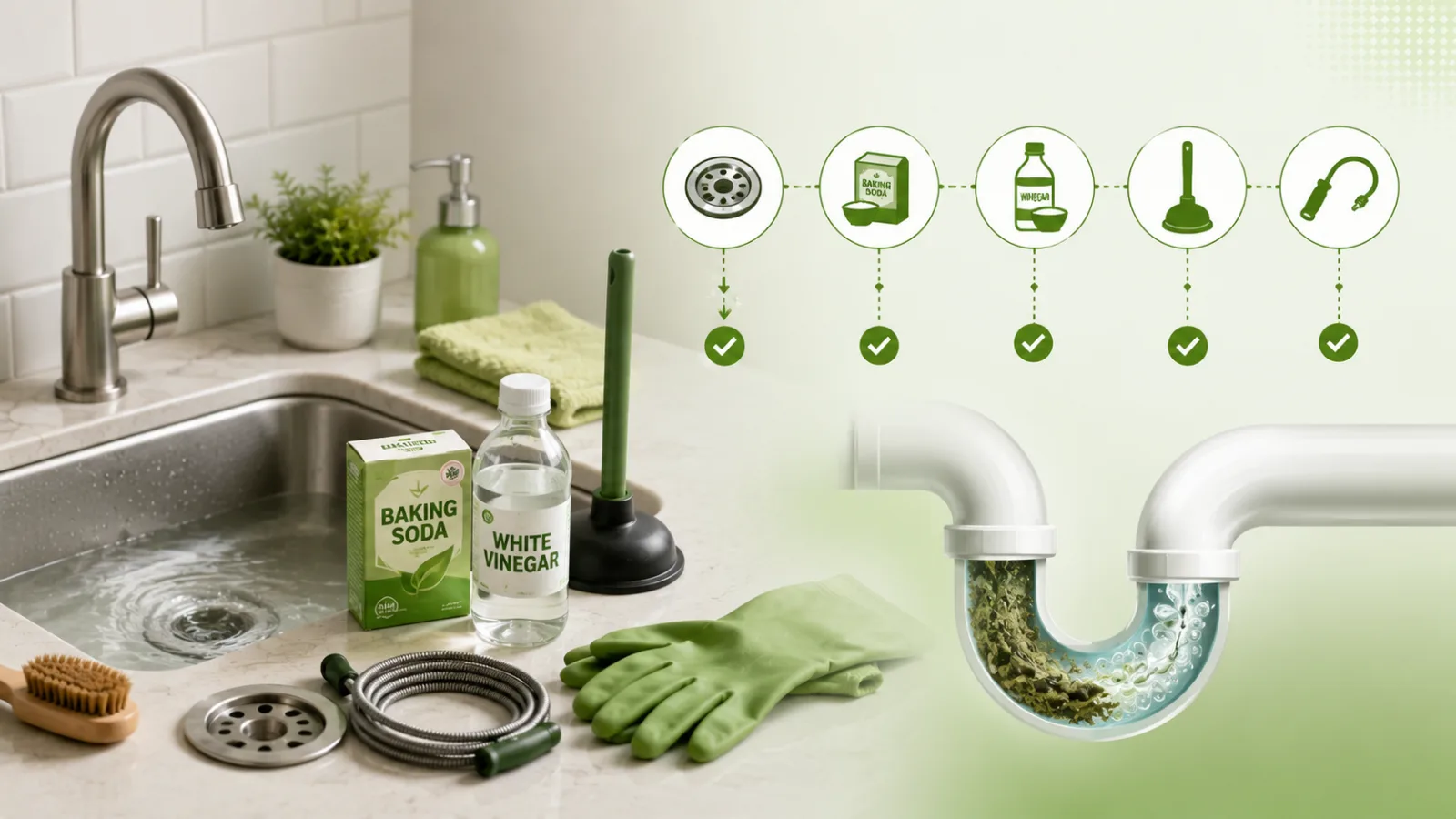
Here is what to do instead, in the order to do it.
1. Clear the trap and the stopper
For a bathroom sink or a shower, this alone solves it more often than not. The blockage is usually hair and soap within a foot of the drain.
- Pull the sink stopper out. Many lift straight out; some need a pivot rod behind the drain to be unclipped first.
- For a shower, unscrew the drain cover.
- Use a plastic hair-removal strip — the cheap barbed ones. Fish, do not push.
It is unpleasant and it works.
2. Boiling water and dish soap — kitchen sinks only
Kitchen clogs are usually congealed grease. A generous squeeze of dish soap followed by a kettle of near-boiling water poured in stages will often break it down.
Do not do this on a toilet — thermal shock can crack porcelain. And do not do it if you have already used a chemical cleaner.
3. Plunge it properly
Most people plunge wrong. The technique:
- Use a cup plunger for sinks, not the flanged toilet one.
- Make sure there is enough standing water to cover the plunger cup — you are moving water, not air.
- Block the overflow with a wet cloth. On a double sink, block the other drain. Otherwise the pressure just escapes.
- Push and pull steadily for twenty seconds. It is the pull that dislodges most clogs, not the push.
4. Open the P-trap
The U-bend under the sink. Put a bucket under it, unscrew the two slip nuts by hand, and take it off. Clean it out, check the pipe going into the wall, reassemble hand-tight and run the tap while watching for drips.
This is a fifteen-minute job and it catches most kitchen and bathroom sink clogs that survive plunging.
5. Snake it
A cheap hand auger reaches a few feet beyond the trap. Feed it in, crank slowly, and pull back with the same care you fed it in. If you hit something solid and cannot pass it, stop — forcing a cable can damage older pipe, and at that point the clog is beyond hand-tool range.
Stop and call a plumber if any of this is true
These are not "try harder" situations.
More than one fixture is affected. A single slow sink is a local clog. Several fixtures backing up at once means the main line, and that needs clearing through a cleanout with a machine.
A toilet gurgles when the washing machine drains, or water appears in the shower when you flush. Classic main-line symptoms. Fixtures are venting through each other because the main is restricted.
It backs up in the lowest fixture in the house. Basement shower, ground-floor toilet. Water finds the lowest exit, and that is where a main-line blockage shows first.
It keeps coming back in the same place. That usually means something structural — a belly in the pipe, root intrusion, or a fitting that has shifted. A camera inspection ($150–$400) finds it, and is cheaper than clearing the same line three times a year.
You have already used a chemical cleaner and it did not work. Now it is a safety issue as well as a plumbing one.
What it costs to hand over
Clearing a single blocked fixture typically runs $110–$350. A main line blockage, where the machine goes in through a cleanout and travels much further, is more like $250–$600.
Past the point of plunging? See the plumbers listed near you with their published prices, or leave your email to hear the day one joins: drain cleaning near you →
Keeping it clear
- A drain screen in every shower and bathroom sink. The cheapest plumbing decision available.
- Grease goes in the bin, not the sink — including bacon fat, sauces and dairy. It is liquid when it goes in and solid twenty feet down the line.
- Run cold water while using the disposal, and for thirty seconds after. Cold keeps fats solid so they get chopped and flushed rather than coating the pipe.
- Coffee grounds and eggshells are not disposal food, whatever anyone says. They accumulate.
On Task Masters, if it cannot wait, you can post an urgent request, and any plumber listed nearby is alerted straight away.