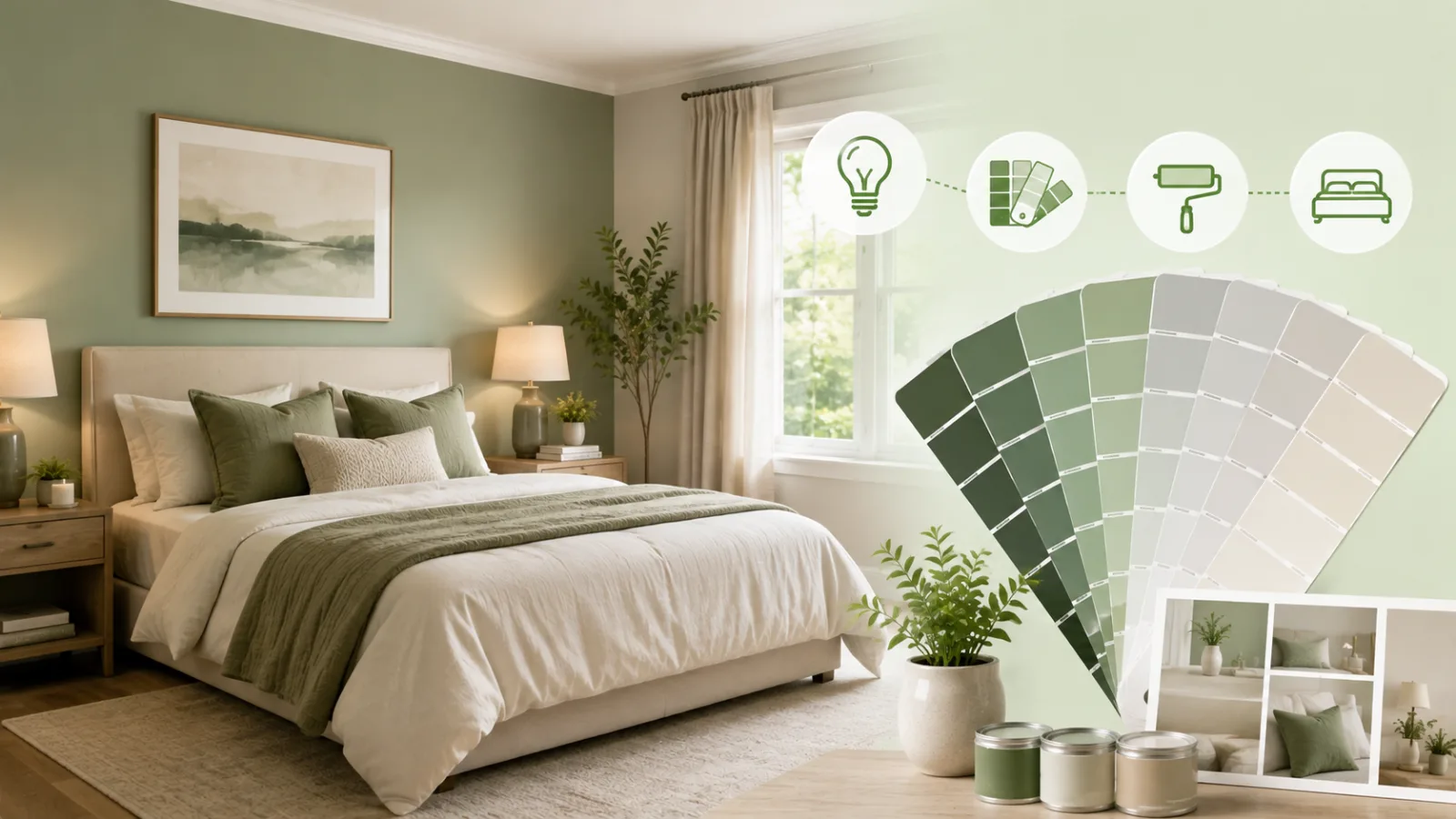
Almost everybody chooses paint the same way — a swatch under a store's fluorescent lights, a decision in ten minutes, and a repaint eight months later. The method below takes two days of nothing but waiting and prevents that entirely.
The single most important thing: which way does the window face?
Natural light has a color, it changes through the day, and it changes with orientation. This affects your choice more than any trend does.
North-facing rooms get cool, indirect, blue-shifted light all day. Cool colors go colder and grey — a soft grey-blue that looked calm on the swatch reads as a hospital corridor. Warm colors are your friends here: soft whites with a yellow or red base, warm greiges, muted terracotta, deep greens with warmth in them.
South-facing rooms get warm, generous light most of the day and are the most forgiving. Cool colors are gorgeous here, and this is where blues, greens and true greys actually behave the way they do on the card.
East-facing rooms get warm direct light in the morning and cool flat light by afternoon. Since a bedroom is used mostly at either end of the day, test what a color does at 7am and at 9pm rather than at noon.
West-facing rooms are the reverse: cool in the morning, strong golden light in the evening. Colors with a lot of yellow can go orange at sunset.
For a bedroom specifically
The room's job is winding down and waking up, so consider it at the light levels it is actually used in.
- Deep, muted colors work far better in bedrooms than people expect. Dark green, navy, deep clay, charcoal. A bedroom is not a room you need bright, and a dark room reads as enveloping rather than small. The old rule that dark colors "shrink" a room is mostly untrue and it costs people the best option available.
- Avoid high-chroma saturated colors — bright reds and oranges especially. They are stimulating, and that is the opposite of the brief.
- The ceiling is a fifth wall you look at from bed. Flat white is fine. A shade lighter than the walls is often better than default white.
How to test properly
This is the whole method, and skipping it is why people repaint.
- Buy sample pots for your three finalists. Not swatches — actual paint.
- Paint big patches, at least two feet square. A small patch is overwhelmed by the color around it and tells you almost nothing.
- Paint them on more than one wall — one that gets direct light, one that does not. The same paint on two walls of one room can look like two colors.
- Do not paint straight onto the existing color. The old color bleeds through and skews everything. Paint a sheet of white poster board instead and move it around the room.
- Look at it for two days. Morning, midday, evening, and at night under the lamp you actually use. That last one matters most in a bedroom and is the one everybody skips — a warm 2700K bulb pulls every color yellow.
Sheen matters as much as color
- Flat or matte hides wall imperfections best and is the usual choice for bedroom walls and ceilings. Less scrubbable.
- Eggshell is a good middle ground — a slight sheen, more washable, still forgiving.
- Satin or semi-gloss for trim, doors and windows, where the durability is wanted and the contrast in sheen is what makes the trim read as trim.
The higher the sheen, the more every bump and roller mark shows. On a wall that is not perfectly flat, matte is doing you a favour.
What painting a room costs
If you are handing it over: interior painting typically runs $350–$900 for an average bedroom, walls and ceiling, two coats — roughly $2 to $6 per square foot of floor area. Quotes vary mostly on scope rather than skill, so ask explicitly whether the number covers the ceiling, the trim, the doors and the closet interior. That is the usual reason two quotes for "painting a room" are not comparable.
The other thing you are paying for is preparation — filling, sanding, caulking and cutting in by hand. That is where the time goes and where a professional finish comes from. The rolling is the fast part.
Picked a color? See the painters listed near you with their own published prices, or leave your email to hear the day one joins: interior painting near you →
And if the walls need filling and sanding before anything else, that is a job of its own: drywall repair →